Articles

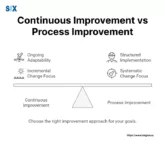
Image: Continuous Improvement vs Process Improvement

The Strategic Edge: Continuous Improvement vs Process Improvement

Business excellence requires a clear understanding of different improvement approaches. Organizations must choose between continuous improvement’s gradual evolution and process improvement’s targeted transformations – or implement both strategically. The distinction between continuous improvement and process improvement methodologies has become crucial for business leaders seeking to enhance their operational efficiency and drive sustainable growth. Key Highlights […]

View More

Image: What is Hansei

Hansei: Mastering the Japanese Art of Self-Reflection for Continuous Improvement

Hansei is a concept of self-reflection that has been adopted by many organizations and has become crucial in the achievement of improvement in organizations across the globe. This great tool that is embedded in the Japanese business culture is not just reverse thinking – it is a process that has helped me tremendously in working […]

View More

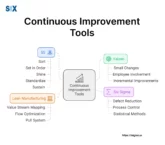
Image: Continuous Improvement Tools

Continuous Improvement Tools and Techniques. Everything You Need to Know

Continuous improvement tools signify consistent enhancement of offerings, techniques, and services via lean philosophy, Six Sigma, Kaizen, and other routines refining operations persistently. The core of these tools is geared toward optimizing processes, lessening defects, slashing wasted efforts, and improving proficiency. By harnessing different instruments, organizations get insights pinpointing friction spots and cogs for precise […]

View More

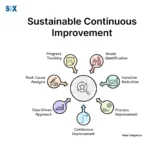
Image: Sustainable Continuous Improvement

Continuous Improvement Strategies. A Guide to Sustainable Continuous Improvement

For companies to keep up nowadays, always changing and getting better proves key. Sustainable continuous improvement forms an excellent foundation for decades via methods like lean, Six Sigma, and kaizen streamlining procedures. Perpetually refining techniques, outputs and services minimizes environmental imprint while emphasizing shared responsibility cultivates viability, waste-reduction, and societal contributions. So, enterprises enhance competitiveness, […]

View More

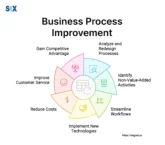
Image: Business Process Improvement

Business Process Improvement: Why Every Company Should Implement It

Business Process Improvement is a systematic approach to identifying, analyzing, and enhancing existing business processes to achieve greater efficiency, effectiveness, and overall performance. Business Process Improvement serves as a critical tool in this endeavor, offering a structured methodology to streamline workflows, reduce costs, and ultimately deliver superior value to customers. Key Highlights Introduction to Business […]

View More

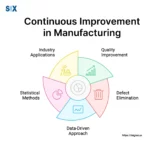
Image: Continuous Improvement in Manufacturing

What is Continuous Improvement in Manufacturing? Lean Manufacturing Techniques

Manufacturing organizations must consistently better output/quality/value to stay ahead of rivals. This endeavor is called continuous improvement in manufacturing. It’s become pivotal for factories worldwide. Continuous improvement means using methods like Lean Production, Kaizen, Six Sigma, and Total Quality Management in a structured way. These aid in detecting and executing refinements. Core aims involve optimizing […]

View More

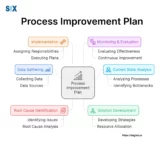
Image: Process Improvement Plan

The Importance of Having a Process Improvement Plan for Your Business

A process improvement plan is a strategic roadmap designed to enhance organizational efficiency, reduce waste, and boost overall performance. It’s a systematic approach that combines data-driven analysis with proven methodologies to identify, implement, and sustain meaningful changes in business processes. Key Highlights Understanding Process Improvement Plan Process improvement plan is the backbone of any successful […]

View More

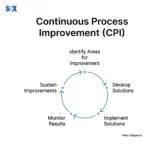
Image: A circular diagram depicting the Continuous Process Improvement (CPI) Cycle

Continuous Process Improvement (CPI): A Guide for Businesses

Continuous process improvement (CPI) describes identifying, outlining, implementing, measuring, and analyzing effectiveness shifts within an organization’s workflows. Surpassing the notion that “unbroken works best”, this recognizes that even flowing operations can benefit from refinement and optimization. Key Highlights What is Continuous Process Improvement? Continuous process improvement (CPI) is the cornerstone of operational excellence and long-term […]

View More

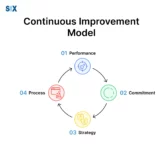
Image: Continuous Improvement Model

Process Improvement Methodologies. What is the Continuous Improvement Model

Keeping up with the changing market dynamics and customer needs is key to survival. This calls for a continuous improvement model in business processes, products/services, etc. to gain and maintain an edge over competitors. The continuous improvement model is a systematic approach to identifying and implementing incremental changes to drive efficiency, reduce waste, improve quality, […]

View More

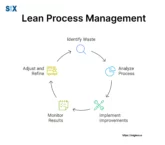
Image: Lean Process Management

Lean Process Management: Streamlining Operations & Driving Excellence

Lean process management has proven itself as a transformative framework for organizations seeking optimized functions, refined workflows, and superior value deliverances. Centered on the unrelenting elimination of wastage while streamlining processes and cultivating persistently uplifting mindsets, this strategic vision finds foundations in the Toyota Production System. Revolutionizing manufacturing industries through prioritizing fluid productions, respecting contributors, […]

View More

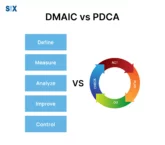
Image: DMAIC vs PDCA

DMAIC vs PDCA in Six Sigma. What Should You Pick and Why

Associations consistently search for approaches enhancing methodologies, quality, and proficiency. DMAIC (Define, Measure, Analyze, Improve, Control) and PDCA (Plan, Do, Check, Act), otherwise called the Deming or Shewhart cycles, end up noticeably useful in this quest. While both serve non-stopping upgrades and issue arrangements viably, they vary regarding technique, degree, and particular applications. DMAIC depends […]

View More

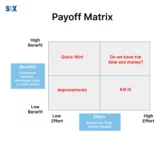
Image: Payoff Matrix

Mastering Payoff Matrices: Power of Strategic Decision-Making Tools

Navigating intricacy and choosing prudently hold prime significance. Fortunately, payoff matrix emerge as potent sense-makers. Through over two decades guiding transformational change, I’ve witnessed matrices’ gifts firsthand time and again across various terrains. Essentially, these visual organizers furnish structured comprehension beyond instinct. By mapping options and their effects, matrices illuminate the nuanced interweaving amid counterpart […]

View More

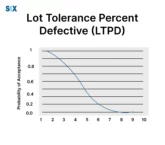
Image: Lot Tolerance Percent Defective (LTPD)

LTPD (Lot Tolerance Percent Defective) in Lean Six Sigma

Quality checks assume pivotal jobs in each assembling or creation process. Representative testing utilizes tests on item tests rather than each. Inside this, the Lot Endurance Percent Detrimental (LTPD) assumes a basic part in choosing regardless of whether a delivery or outfit ought to be acknowledged or dismissed given imperfection levels. Key Highlights What is […]

View More

Image: Gemba Walk

A Complete Guide to Gemba Walk. All You Need to Know

As priorities evolve to sustainability and shared prosperity, forward-thinking enterprises appropriately focus on judicious refinement and progress empowering all. One impactful philosophy gaining adoption involves Gemba walks – where leaders immerse experientially within core functions to uncover strengths, strengthen understanding, and jointly resolve opportunities alongside dedicated teams. Go where the work happens and uncover powerful […]

View More

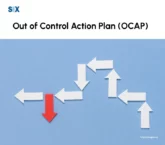
Image: Out of Control Action Plan (OCAP)

Out of Control Action Plan (OCAP): A Proven Framework for Sustained Process Control

Keeping methods on track and actually meeting goals is incredibly important. Even the best-designed and implemented processes can experience hiccups or drifts that undermine results and productivity. This is where having an Out of Control Action Plan or OCAP makes a difference – it’s an essential contingency map for organizations to quickly tackle and fix […]

View More

Lean Six Sigma Consultant for Help

How Does Your Consultant Stack Up?

Even large companies need help. When a company is in dire of change, it seeks help when internal resources are not considered sufficient. They explore the possibility of engaging consultants who can recommend ways to bring about desired changes. The decision to seek outside help is explained by current thinking that a consultant can take […]

View More

Image: How to Earn Fat Salaries as a Lean Consultant

Six Sigma Consultant: How Much Should I Charge for My Services?

So you’re a consultant, now what? A lot of Six Sigma practitioners ask the same question. Before rushing into any new projects, make sure you understand how much you should charge. It’s essential to your career development that you learn how to charge appropriately. Not all consulting firms are alike, and some will specialize in […]

View More

Image: Techniques for Root Cause Analysis (RCA)

Techniques for Root Cause Analysis (RCA)

Cause and Effect Diagram, Fishbone Diagram or Ishikawa diagram, is an widely used tool to help users to find the roots causes of the problems they are investigating. The approach combines brainstorming and a concept map. The process has four major steps: identifying the problem; working out the major factors involved; identifying possible causes and […]

View More

Six Sigma RCA Training - Decision Trees

How to Create a Decision Tree for Root Cause Analysis

Root Cause Analysis is an invaluable skill to have in your Six Sigma toolkit. But how do we use Root Cause Analysis to the best effect? What tool is most helpful for this task? That would be the Decision Tree. This method involves branching between causes and outcomes to illustrate the consequences of your choices. […]

View More