Articles

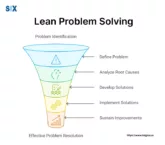
Image: Lean Problem Solving

Lean Problem Solving Techniques. The Definitive Guide to Operational Excellence

In today’s fast-paced business world, efficiency isn’t just an advantage — it’s a necessity. This powerful methodology isn’t just a tool; it’s the secret weapon that sets successful companies apart from their competitors. Whether you’re a seasoned business professional, a project manager looking to streamline operations, or a process improvement enthusiast eager to make a […]
View More

Image: Top Industry Specific Problem Solving Techniques

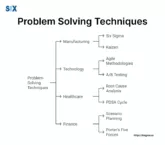
20 Powerful Problem-Solving Techniques for the Modern Workplace: A Comprehensive Guide

Here’s a fact… Organizations that are great at solving problems are about 3.5 times more likely to grow their income faster than other companies! But what’s so crucial about problem-solving that makes such a big impact? What is Problem-Solving? Problem-solving is about finding and fixing issues that stop a company from reaching its goals. Being […]

View More

Image: SCAMPER Technique

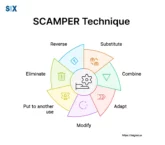
SCAMPER Technique: Drive Innovation & Creativity

SCAMPER presents a principled creativity approach. It encourages out-of-box exploration and perspective flexibility to nourish insight. For progress-seekers committed to cooperation and solutions uplifted through understanding as one, SCAMPER emerges as a trusted companion. Key Highlights What is the SCAMPER Technique? The SCAMPER technique is a powerful creative problem-solving and brainstorming method that organizations across […]

View More

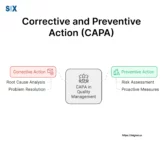
Image: Corrective and Preventive Action (CAPA)

Corrective Action and Preventive Action (CAPA). The Only Guide You Need

Quality, compliance, and continuous improvement are key for consistent growth and survivability for organizations irrespective of industry. The corrective and preventive action (CAPA) is a structured approach that enables organizations to identify, analyze, and address nonconformities, deviations, and potential risks merging with the practical knowledge and Six Sigma Certification. A critical aspect of achieving these […]

View More

Image: Future Reality Tree

Master Future Reality Trees: Engineer Your Ideal Future State

The Future Reality Tree technique builds upon the Theory of Constraints, empowering organizations to envision their ideal future state and forge a path toward lasting success. The FRT forms a logical structure that maps the connections between proposed approaches (“injections”) and the desirable outcomes they aim to achieve. It guides you through a careful process […]

View More

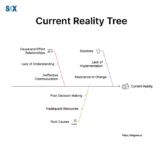
Image: Current Reality Tree

Current Reality Tree: A Powerful Tool for Root Cause Analysis and Improvement

The Current Reality Tree stands out as an insightful method for tackling intricate, deep-seated issues that organizations face. With roots in the Theory of Constraints, the CRT provides a clear way of systematically understanding problems. By mapping how undesirable events and effects are all connected, and tracing them back step-by-step to the core drivers behind […]

View More

Image: TRIZ (Inventive Problem Solving)

Unlocking Innovative Solutions with TRIZ: A Powerful Problem-Solving Methodology

Businesses constantly search for innovative fixes to stay ahead and handle complex puzzles. But creation paths often hit snags, contradictions, and walls that seem impossible to climb. This is where TRIZ, the Theory of Inventive Problem Solving, shows its worth with a powerful method fueling breakthrough solutions and a constantly upgrading culture. Developed decades ago […]

View More

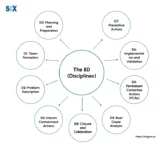
Image: 8D Corrective Action

8D Corrective Action: Mastering Problem-Solving for Continuous Improvement

Businesses constantly refine products, services, and workflows to stay ahead. But issues can still pop up, angering customers and jacking costs while hurting a company’s image. This is where the 8D corrective action problem-solving method earns its stripes. It was developed by Ford in the 80s and has since spread widely across manufacturing, healthcare, aerospace, […]

View More

Image: Defect Concentration

Complete Guide to Defect Concentration Diagram in Lean Six Sigma

Finding and fixing flaws in products is super important. Defect Concentration Diagram or DCD have become a helpful visual method teams use. These diagrams provide an easy-to-understand picture of where faults happen, how often, and if there is a pattern. They map issues right onto a graphic of the item or part. DCDs offer a […]

View More

Image: Risk Priority Number (RPN) in FMEA

Lean Six Sigma Strategies – Risk Priority Number (RPN) in FMEA

The Risk Priority Number (RPN) is a scoring system used in risk management to rank the severity, likelihood of occurrence, and detectability of potential problems. RPN is a multiplication of three key factors: severity, occurrence, and detection. Want to transform how your organization identifies and mitigates risks? Learn powerful tools like RPN to drive data-informed […]

View More

Image: How to Use Input Process Output Model For Business Success

How to Use Input Process Output Model For Business Success

Teams are the backbone of modern organizations, driving innovation, problem-solving, and organizational success.  However, building and sustaining high-performing teams is a complex endeavor that requires a deep understanding of the underlying dynamics and processes. Learn systematic approaches to enhance group dynamics and productivity Transform Your Team’s Performance with Lean Six Sigma Green Belt Certification. This […]

View More

Effective Problem Solving with a Problem Statement

Effective Problem Solving with a Problem Statement

On an ongoing project or task, you will likely need to solve problems with some unique skillset and methodology. When things get tough, you may want to show your employer the complex challenge that might arise in your job. This is where effective problem-solving skills shine and makes it one of the most sought-after talents […]

View More

pdca plan do check act

The PDCA Cycle as Part of the Continuous Improvement Process

There are many great tools and templates used in Six Sigma, and today we are going to spend a little time with PDCA (Plan-Do-Check-Act). PDCA is a template or cycle used for problem solving. W. Edwards Deming originally created PDCA way back in the 1950s, and his intentions were to use PDCA with a continuous […]

View More

Image: Six Sigma A3 Process

Lean Six Sigma A3 Process Keeps Problem Solving Organized

When problem-solving, staying in an organized systematic path is extremely important, otherwise, new issues could arise. That’s why the Lean Six Sigma approach called A3 is so genius. Basically, the A3 process is a structured template for solving problems in a continuous matter. The A3 approach is also known as SPS, which stands for Systematic […]

View More