Articles

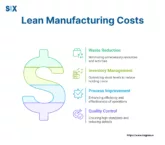
Image: Lean Manufacturing Costs

Lean Manufacturing Costs: The Guide to Slashing Production Expenses

Companies implementing lean principles report an average 20-30% reduction in operational costs within the first year alone. That’s not just marginal improvement—it’s transformative change that directly impacts the bottom line. When manufacturers face mounting pressure to deliver higher quality at lower costs, lean manufacturing emerges as the proven methodology that consistently delivers results. Ready to […]
View More

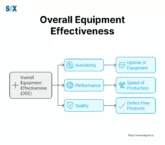
Image: What is Overall Equipment Effectiveness (OEE)

The Ultimate Guide to Overall Equipment Effectiveness (OEE): Mastering Calculation, Implementation, and Optimization

Efficiency isn’t just a goal—it’s a necessity for survival and growth. This is where Overall Equipment Effectiveness (OEE) comes into play, serving as the gold standard for measuring productivity and identifying opportunities for improvement in your operations. Key Highlights We’ll dive deep into the world of Overall Equipment Effectiveness (OEE), covering everything from basics to […]

View More

Image: Takt Time vs Cycle Time vs Lead Time

Lean Manufacturing – Takt Time vs. Cycle Time vs. Lead Time. A Definitive Guide

Takt time is about production speed to match clients’ consumption rates. It safeguards productions stay in market synch. Cycle time measures precise moments devoted to finishing manufacturing from commence to endpoint. This finds bottlenecks and boosts throughput.   The lead time contains client requests’ entire tenure spanning submittal, output, and delivery. It surrounds procuring through shipping […]

View More

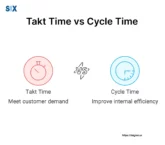
Image: Takt Time vs Cycle Time

Takt Time vs Cycle Time in Lean Manufacturing. A Complete Guide.

To effectively achieve lean manufacturing, two important things to know are takt time and cycle time. Takt time is the speed needed to make products to match what customers want. It’s calculated by dividing work time by what customers will buy. Cycle time is the actual time it takes to make one item fully from […]

View More

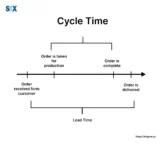
Image: Cycle Time

Understanding Cycle Time: Definition, Calculation, and Importance

For enterprises crafting, producing, or running workflows repetitively, cycle time/duration is crucial for effectiveness estimation and better spotting. Cycle time, likewise termed lead time alludes to a full period from starting one repeating assignment to end whether vehicle assembly lines, programming undertakings, or building activities, abbreviating it unlocks refined functioning, waste deduction, and greatest yields. […]

View More

Image: Andon Cord

Andon Cord in Lean Manufacturing. Toyota Production System

In lean manufacturing, the andon cord represents empowerment, quality focus, and constant upgrading. This clever idea from Toyota’s famous production model has transformed manufacturing management. It places quality ownership directly with assembly line employees. The andon cord, often a brightly colored rope along the production line, acts as a straight connect between workers and their […]

View More

Image: What is Mura in Toyota Production System

What is Mura, Toyota Production System? All You Need to Know

Mura, a Japanese term, denotes unevenness within manufacturing or workflow. It comprises one type of waste alongside muda and muri per the Toyota Production System, lean’s foundation. Forms involve demand fluctuations, unbalanced workloads, and variable cycle times. Mura enables muri, overburdening employees, tools, and processes. This decreases productivity and quality while wasting resources. Thus eliminating […]

View More

Image: Improve Quality & Processes with First Pass Yield

First Pass Yield (FPY) in Manufacturing. Lean Six Sigma

Manufacturers must always improve their processes to keep costs down and customers happy. An important metric that has transformed how companies evaluate and boost the quality of their production is First Pass Yield or FPY. The FPY simply tells you what percentage of items go through the manufacturing process without needing any extra work or getting […]

View More

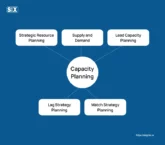
Image: Capacity Planning

What is Capacity Planning? Types, Strategies & Best Practices

Effective capacity planning plays in the success of any organization, regardless of its size or industry. Capacity planning is all about figuring out how much work your organization can handle, whether producing goods or delivering services, to meet the demands of your customers. It’s like planning how many ingredients you’ll need to bake a cake – […]

View More

Image: Time Study Analysis

Drive Operational Excellence with Time Study Analysis. The Ultimate Guide

Organizations across industries are constantly seeking ways to enhance their operational efficiency, optimize resource utilization, and drive continuous improvement. Among the arsenal of tools available to process improvement professionals, time study analysis stands out as a time-tested and invaluable methodology. At its core, a time study analysis is a systematic approach to observing, measuring, and […]

View More

Image: Takt time for Production Excellence

Takt time for Production Excellence. Calculate and Implement

Takt time is a foundational concept in lean manufacturing that helps organizations match production with customer demand.  The term “takt” comes from the German word taktzeit, which translates to “cycle time”. It is the maximum time allowed to produce one piece without falling behind or getting ahead of customer demand. Transform your manufacturing processes from […]

View More

Image: Pilot Run in Six Sigma

Pilot Run in Six Sigma. A Complete Guide (2025)

Whether it’s a new product launch, a significant process change, or an increase in production volumes, a pilot run serves as an invaluable opportunity to validate processes, identify potential issues, and refine operations before committing substantial resources. By understanding the nuances of pilot runs, manufacturers can mitigate risks, optimize processes, and ultimately deliver high-quality products […]

View More

Image: JIT manufacturing

Important Principles of JIT Manufacturing

How does an organization sell all goods manufactured while lowering costs and increasing customer satisfaction? One of the best ways to achieve this is through just-in-time manufacturing, (JIT). It is a Lean thinking philosophy that focuses on demand-based production, as well as the production of quality products and organization-wide continuous improvement. It is a system […]

View More